Copying and Reproducing Original Artwork
Whether you are a working artist who needs archival-quality reproductions to sell, or someone who wants to make a print from a family heirloom painting, copying original artwork is one of the more nuanced services we offer at Yellow Lab Imaging. The process involves choices about how the image is captured, how color is managed, and what materials the final print is produced on — and those choices matter more here than they do for standard photo printing.
Here is what you need to know before starting a reproduction project.
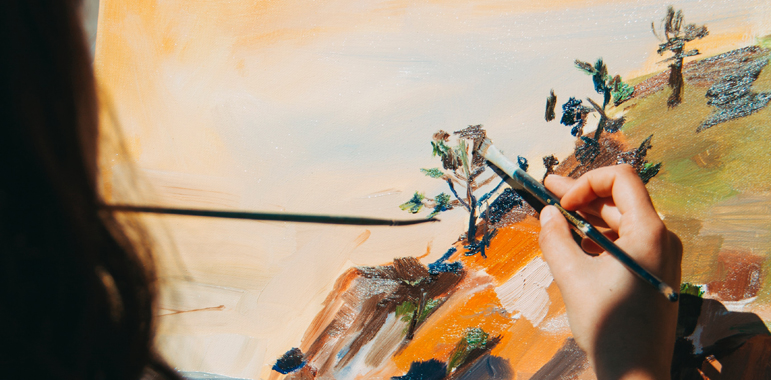
Two Ways to Start: Your File or Our Scan
There are two ways to approach a reproduction project, and which one is right for you depends on how much control you want over the color accuracy of the final print.
Option 1 — You provide the file. If you already have a high-resolution digital file of your artwork — whether you scanned it yourself, had it professionally scanned elsewhere, or photographed it with a quality camera setup — we can print directly from that file. This is the faster and simpler path. The trade-off is that I have no control over how the image was captured. If the scan or photo is slightly off in color, exposure, or sharpness, those issues carry through to the print. I print what I receive.
Option 2 — We scan it here. If color accuracy is a priority — and for many artists it is — having us scan the original is the better choice. Our scanning equipment is calibrated, and our monitors are hardware-calibrated using a Datacolor Spyder 5 Pro that reads both monitor output and ambient light. We also apply the ICC profile for the specific paper we are printing on. That combination gives us the tightest possible control over the path from original artwork to finished print.
For artists who are particular about color — and in our experience, most serious artists are — the scanning step is worth doing right. A reproduction that is slightly warm, slightly cool, or slightly desaturated compared to the original is a frustrating result after all the effort that went into making the piece. Starting with a calibrated scan eliminates most of that risk.
Getting the Original to Us for Scanning
If you decide to have us do the scanning, there are two options depending on where you are located.
In-person drop-off: If you are in or near East Tennessee, we can arrange a drop-off time for you to leave the work with us. We complete the scanning, then you come back to pick up the original along with your finished prints. This is ideal for larger pieces or anything particularly fragile or valuable that you are not comfortable shipping. Contact us to arrange a drop-off.
Mail-in: For clients outside the area, original artwork can be shipped to us. Please contact us before sending anything. We will walk you through how to pack your specific piece safely for transit — the right approach varies depending on whether it is a framed canvas, a flat paper work, a panel, or something else. Do not ship originals without talking to us first.
What Kinds of Artwork We Reproduce
Oil and acrylic paintings — The most common request. Surface texture is captured well in scanning and adds character to the reproduction, particularly on fine art papers and canvas.
Watercolor and gouache — The subtle washes and paper texture of watercolor scan beautifully. Fine art papers, particularly velvet, suit watercolor reproductions especially well.
Drawings — pencil, charcoal, ink, pastel — Line-based work reproduces with excellent sharpness. High contrast drawings often look striking on Lustre or Pearl paper.
Mixed media — Contact us to discuss. Results vary depending on the materials involved, and we would rather talk through the specifics than make general promises.
Children's artwork — A specialty of ours. See our children's artwork page for more on this.
Print Options for Reproductions
Once we have a quality file, the reproduction can be printed on any of our standard materials. The right choice depends on what the artwork looks like and how the print will be used.
Fine Art papers (Matte or Velvet) are the traditional choice for artwork reproductions, particularly for gallery prints and archival editions. Matte paper suits high-contrast and graphic work. Velvet suits paintings with rich color and texture. Both use pigment inks on archival paper rated for 100+ year longevity.
Lustre is a good choice when the reproduction will be handled, framed without glass, or used in a context where fine art paper is not required. It is more affordable and still produces a professional result.
Canvas gallery wraps are a natural fit for painting reproductions — particularly oils and acrylics — where a textured surface reinforces the character of the original. Each canvas is hand-built to fit the specific image and finished with two coats of UV protectant.
Metal prints give reproductions a vivid, high-contrast look that suits bold, graphic, or heavily saturated work. Not a traditional choice for fine art, but striking for the right pieces.
Sizing and Editions
Reproductions can be printed at any size up to 44 inches wide, at any length. We can produce a single print or a small run of identical prints for artists selling limited editions. If you are producing a limited edition, talk to us about consistency — we keep files and can reprint from the same calibrated source for subsequent orders in the same edition.
Ready to Start?
The first step is a conversation. Contact us here or call 913.217.7202 to discuss your project. We work with artists and families across the country and ship nationwide. If you have a piece of work that deserves to exist as more than a single fragile original, we can help you make that happen.
Related Yellow Lab Imaging Services
Ready to turn your images into something lasting? Browse our photo prints online, order 3x3 photo prints, explore square prints online, or learn more about our photo scanning services.