How Photo Restoration Works
Most families have photographs that have not held up well over time. A portrait from the 1940s with deep cracks running across the face. A faded wedding photo where the colors have shifted to orange. A water-damaged print where an entire corner is gone. These are not lost causes — they are restoration projects, and bringing them back is some of the most satisfying work we do at Yellow Lab Imaging.
Here is how the process works, from the moment you contact us to the moment you hold the finished print.
Step 1 — The Consultation
Every restoration starts with a conversation, not a quote. The reason is simple: asking me to estimate the cost of a restoration without seeing the photograph is a lot like asking a contractor to quote a paint job over the phone without seeing the house. The damage level, the size of the original, the complexity of what needs to be rebuilt — all of that determines how long the work will take, and I will not guess at it.
To get started, contact us with a description of what you have and what you are hoping to achieve. We will set up an appointment to review the photograph together. For clients who are not local to East Tennessee, you can email a photo of the damaged image and we can give you a general sense of feasibility before you commit to anything.
Step 2 — Scanning the Original
Once we have reviewed the project and agreed to move forward, the original photograph is scanned at high resolution using professional-grade equipment. This creates a detailed digital file that captures every crack, fold, stain, and fade in the original — and gives us the raw material to work with without ever touching or risking the physical print again.
The original photograph is handled with care throughout this process. It is returned to you along with the finished restoration print.
Step 3 — Digital Restoration in Photoshop
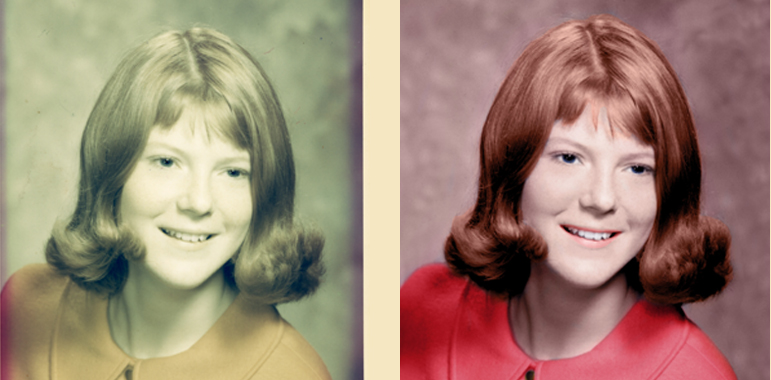
This is where the real work happens. Using Adobe Photoshop, I work through the damage methodically — removing scratches and dust, rebuilding torn or missing areas, correcting color shift and fading, and restoring contrast and tonal depth. This is done by hand, pixel by pixel. There are no AI filters or automation shortcuts involved. Every decision about what a restored area should look like is a judgment call made by a trained eye.
The goal is always to restore what was there, not to reimagine the image. I am not adding artistic interpretation — I am recovering what time and damage have obscured. That means the finished print should look like what the original was meant to look like on the day it was taken, not like a modern photo processing job applied to an old image.
Restoration is billed at an hourly rate with a one-hour minimum. More complex projects — severe water damage, large missing areas, extensive fading across an entire print — naturally take more time. I will give you a realistic estimate of hours before starting work.
Step 4 — Printing on Archival Materials
Once the digital restoration is complete and you have approved the result, the image is printed on archival-quality paper using archival inks. That combination is rated to last 100+ years when framed under glass, kept away from moisture and direct sunlight — far longer than the original print is likely to survive.
Most restoration prints are produced as standard Lustre prints, which give excellent color accuracy and a clean, professional finish. For display-worthy restorations, canvas gallery wraps and gallery mounts are also available options.
What Kinds of Damage Can Be Restored?
Cracks and tears — One of the most common issues in older prints. Cracks can be removed digitally regardless of how severe they are, as long as there is enough visual information on either side to guide the reconstruction.
Fading and color shift — Older photos often shift toward orange, yellow, or sepia over time as dyes break down. Color correction can bring these back toward their original palette.
Water damage and staining — Water damage is among the most complex repairs, particularly when it has caused physical warping or complete loss of image detail in affected areas. Results vary depending on severity.
Missing areas — Torn corners, burned edges, and areas where the emulsion has completely lifted can often be reconstructed from context, though highly detailed missing areas (faces, for example) require more time and are not always fully recoverable.
Foxing and mold spots — Small brown spots common in very old prints stored in humid conditions. Usually straightforward to remove digitally.
Scratches and dust — Surface scratches on the print or dust embedded in the emulsion. Generally the most routine restoration work.
What We Cannot Do
Restoration has limits. If a portion of an image is completely gone — burned away, cut off, or destroyed by severe water damage with no remaining detail — there is nothing to recover. We can reconstruct backgrounds and surrounding areas, but we cannot invent detail that was never captured. I will always tell you honestly what is and is not achievable before starting work.
Ready to Get Started?
If you have a photograph that deserves to be rescued, photo restoration service page for full details and pricing, or reach out to us directly. Call 913.217.7202. We serve clients across the United States — you do not need to be local to work with us. We will walk you through the consultation process and let you know what we can do for your photograph.
Related Yellow Lab Imaging Services
Ready to turn your images into something lasting? Browse our photo prints online, order 3x3 photo prints, explore square prints online, or learn more about our photo scanning services.